and has 0 comments
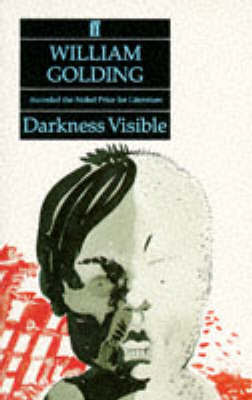
William Golding writes difficult books. They are not only complex in prose and detail, but dissecting difficult subjects as well. Best known for Lord of the Flies, which is a pretty dark and twisted tail of children getting trapped in what is basically a social experiment, he manages to write something even darker in Darkness Visible.

The book follows the story of several characters. There is Matty, a child that emerges from the burning wreck of a bombed building during WWII with half of the body burned. He grows up in the state social system, interacts with Mr. Pedigree, a teacher who is also a raving paedophile, and then spends the rest of his life seeking redemption. He is a simple, almost stupid person, easily influenced, but taciturn and withdrawn most of the time. There there are the two beautiful and very smart daughters of a rich man. With every opportunity given to them, they prefer to dwell on the remoteness of their father and screw their lives completely. And finally Sim and Edwin, two old men passionate about books and good friends, who despite their best intentions and education are not capable of understanding the world and people around them.

Golding uses themes I've seen before: the way people can perceive so differently a shared event, like in Rites of Passage and the almost clinical dissection of the motivations characters have in doing what they do, as in both Lord of the Flies and Rites of Passage. The way he explores the inner, most private triggers of his characters is almost creepy.

The book is not exactly a success. I had a hard time reading it, mostly because of its overly verbose prose, and the presentation of people's lives sometimes goes to incredible extremes, escaping the main story completely. That doesn't mean it is not a brilliant book. One just has to be in the right mood to be able to finish and understand it.

and has 0 comments
Any person that is remotely interested in the history of chess knows the name of José Raúl Capablanca. He was a great chess player and the world champion for 7 years in a row. I've just finished reading one of his books, entitled Chess Fundamentals, and I thought it was great. It featured clear chess principles, backed by real master games and, what I believe it is most important in the book, all the matches featured in Chess Fundamentals are annotated by Capablanca, who focuses on what moves he saw best, the ones he didn't like and, most fortuitous, what he thought when he played those moves, as many of the games are his.

Unfortunately, as with any chess book, one must spend time to focus on the details and to revisit it as many times as it takes to understand and learn what Capablanca wanted to express. I've read the book as part of an iPad application called "e+books". You get the free application, this Capablanca free book, then you have to pay for any other there. What I found really nice is that the positions and moves in the book are mirrored by a chess board that allows navigation between moves, variations, going back and forth, etc. It really helps reading the book and I recommend it, especially for beginners. Using a real chessboard to mirror the moves might be best, but it adds a layer of discomfort and complexity that might deter someone from finishing the book.

The book is structured into 6 chapters, the last being a series of 14 games in which Capablanca either lost or won. He begins with some principles of the endgame, the part of a game that he considers the most important. If you recall, Josh Waitzkin also highly recommended focusing chess training on the endgame, where there are few pieces and the principles become clearer. Also, since some chess games end with mates somewhere in the middle game, there is less opportunity to learn that part of chess. For openings Capablanca has only a few words, focusing on the healthy development of pieces, which he considers the most important. As stated previously, the games are the most important and their complexity is pretty high. Some say that the book is not fit for beginners for that reason alone, but I disagree. Even the most complex strategies are explained in the annotations and I believe they are a rare opportunity for anyone to glimpse in the mind of a chess master and realize where their aim as chess players lies.

All in all a rather easy to read book, with the help of the iPad application, but very hard to completely understand and remember. I intend to return to it, several times perhaps, in order to internalize some of the cool patterns of thought I saw in there. I warmly recommend it.

and has 4 comments
Games People Play: The Psychology of Human Relationships is a sort of summarization of previous works by Eric Berne, the "father" of Transactional Analysis. It was written in 1964, but it is very actual (barring some author views that could be construed as not politically correct in this age of sensitivity). In fact it felt to me so to the point, that I am asking myself how come I've never heard of this book before.

The idea of the book is that all people are torn between their three major components:
  • the Parent - exponent of the social environment, things that "are done" in the "proper" way
  • the Adult - who reacts to the circumstances as they change
  • the Child - the emotional being who craves satisfaction and enjoys life the most
As I see it, is a separation in things one learns from others, things one thinks for themselves and things one likes or dislikes. At the end of the book the author resorts to a similar division: the Jerk, the one that does everything based on what others would think of them, and the Sulk, the one that does everything in order to demonstrate to themselves and others that they are being mistreated by the world and they are justified in their feelings, similar to the Parent and the Child.

Then there is a presentation of Transactional Analysis, an area of psychology that feels more like economics applied to human beings, where people do things in order to settle debts or gain profit. A nice example is two people that work together and say "hi" to each other in passing whenever they meet first in the day. This is equivalent to settling a debt that each have for their level of relationship. If one of them fails to say "hi", the other will feel attacked, just as if one of the two would stop and say "well, hello! How are you?" which would also feel like an attack, one that indebts the other. These transactions are being categorized into simple transactions, pasttimes, etc.

But then the interesting part comes up. It is funny, I felt for the entire length of the read that the chapters are in the reverse order. Each chapter was more to the point and more interesting than the first. I would have organized the book starting from the introduction, then reversing the remaining chapters. The interesting part is about games, which seem like normal transactions, only they have an alternate "tricky" purpose, one that is not obvious to both people in the transaction.

Quite annoyingly, many of the games described in the book apply to the reader. One feels exposed while reading it. With a structured list of these games, one can use the book as a reference to be used for further study. Each game is presented with their purpose, their "thesis" or pretext and expectations, their actors and their "antithesis". A clear warning is sent by Berne, though: the antithesis of a game is just a way to shortcircuit it and refuse to play, not a "solution" for the problems raised by the playing of said game. Indeed, when faced with a person that refuses to play or, worse, blocks their own playing of the game, they become anxious, depressed, maybe violent, depending on how "hard" they play the game.

An interesting ending is the listing of the reasons why games exist from different standpoints: social, personal, emotional, etc. The games are learned and, in that sense, inherited from parents, then from the environment. People that play the same games stick together and people that play different games are growing apart. That pretty much explains why people that come from the same settings get to have the same social standings and work and live in the same world. Sadly, it also explains why social cases need to make enormous efforts to be accepted, to "make it".

Also, the author presents his view of the best psychological mindset, the one he calls Autonomy. It requires three ingredients: Awareness, to be able to see your surroundings as they are, not as you were taught to; Spontaneity, to be able to have access to your own thoughts, unfiltered by other mechanisms; Intimacy, to be able to share what you are, as you are. A kind of a Zen philosophy. He reckons anything less is not quite living, but only going through the motions. I am not sure how I feel about this, right now.

For me, the book was very interesting. In truth, I should reread it, or at least summarize it into a logical schema that I would add to this post. I am not sure I will do that, but I intend to. Afterwards, I would use it as a tool for introspection and for analyzing my interactions with others. Yes, but...

and has 2 comments
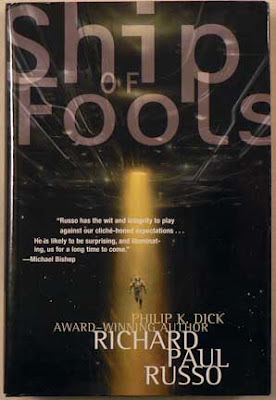
Ship of Fools is a sci-fi book written by Richard Paul Russo. It reads a lot like a journal, written in the first person, with little (or badly evoked) emotional involvement or dynamic action. Add to this that the main character is called Bartolomeo and he is on board of a ship with no history and going nowhere in particular, where there is always a struggle between the captain and the bishop and the people of the lower class, and you kind of get the impression you are reading a Spanish crewman ship log adapted to science fiction. The low focus on technology and the way people are thinking and acting increases the feeling that this is something futuristic only by accident, and the reality of it is some feudal world, only milder than one would expect those dark times to have been. Somewhere in the second half of the book the plot veers slightly towards Event Horizon, an opportunity to make some biblical references. Even then, the book is written in the same linear and descriptive way, despite being in the first person.

The title comes from a long existing concept in Western literature, usually depicting a bunch of ridiculous people travelling together, but without an aim, and also characterizing the society from which they came as a whole. However, the book doesn't really feel like a satire and the fact that it won the Philip K. Dick award in 2001 makes me think that maybe I missed something.

Bottom line: An interesting subject, but approached in a manner that I did not enjoy very much. I could empathize with the main character, but only to a point. When actual technical decisions were made, I thought everybody was kind of stupid. Luckily enough, it is not part of any series, it is a standalone book.

and has 0 comments
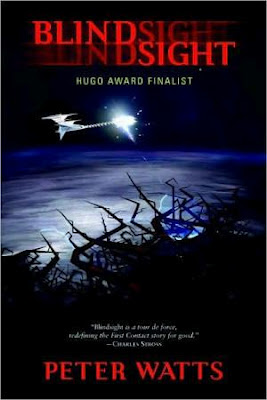
Yes! Another good sci-fi book. Blindsight is a hard science fiction standalone novel in which, using the idea of contact with an impossibly alien species as a pretext, Peter Watts discusses hard subjects like the future of humanity and its very definition, the nature of conciousness and the difference between intelligence and self awareness. It also features vampires (ugh!), but with a good scientific background and true relation to the plot.

There is no romance in this bleak and autopsic book, where the essence of all the characters gets dissected to complete the tableau of the human race under cold fluorescent lighting. Good stuff! But one gets to expect this from Canadian writers, eh? :)

The other cool reason why you should read the book is that it is free at Watts' site: Blindsight. Enjoy!

and has 0 comments
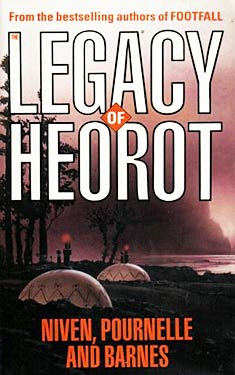
The Legacy of Heorot is a good sci-fi book, part of yet another trilogy: Heorot, written by no less than three authors: Larry Niven, Jerry Pournelle, and Steven Barnes. You've heard of Niven by way of Ringworld, the others are no first time writers either, but I have frankly never heard of them.

The book is about a colony of people on the fourth planet of Tau Ceti. They call it Avalon and the colony Camelot, declaring their ideal of an honest equalist society that has the good of the people at heart. But of course, as the title of the series suggests, the plot moves towards the story of Beowulf rather than any round table. In face of doom and disaster, people tend to go through standard phases, starting with denial, while any façade of equality and reason quickly crumbles.

And this above paragraph pretty much details the subject of the book as well as the reason why I was partly disappointed with it. I was afraid that the story would be yet another actualization of the myth of Beowulf, which would have bored me to hell, but it wasn't. Yet it wasn't really a strong psychological or social commentary either. More of an optimistic view of the first human interstellar colony. Like any government or corporation would spend a whole lot of money on a space ship, in order to send it to another planet and then made it a present to the crew of the ship, fire and forget like. (See how I start and finish sentences with "like", I'm pretty rad, huh?) And all the people there, selected by a well designed process, would be nice and intelligent and having no social pathology at all.

But the book is nice enough, regardless of my bleak and neurotic projections. It focuses on the planet's (very simple) ecology and the way the colonists interact with each other and fight for their prize. They have colonized a small island in order to minimize threats, but there is a huge unexplored continent waiting for them, therefore the trilogy. It was nice, though, that the first book is rather standalone. If you choose to read it and you do not want to continue the series, there is no hook at the end, it just satisfactorily finishes all that was started.

and has 1 comment
I was searching for horror books and I tried this list from a book site. Little did I know that the asshole that wrote the list had a vampire fetish and so he listed all the books with vampires that he ever read.

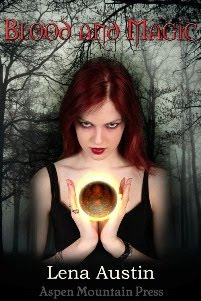
Blood and Magic, by Lena Austin, is not a horror book, it's an adult fantasy book where sexy vampire bitches have sex with magical and well endowed unicorns. That should say enough about the book, and yet I have read it. It was easy to read, being a short single threaded narrative that had the only purpose of getting the main character (said red headed vampire girl) well fucked, respected and pretty much anything she wanted. I am sure sometime in the future will be discovering that she is also a princess of sorts.

This ends my review.

and has 0 comments
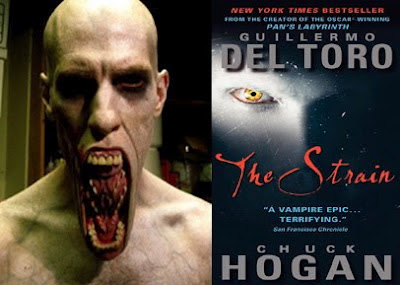
Yes, it's that Guillermo del Toro and he wrote a book, together with this Chuck Hogan dude. Actually he wrote more books, this is part one of the Strain trilogy which, judging by the name, should have been about either a contagion or some sort of pulled muscle, but instead is about vampires.

Now, I don't want to be mean towards poor Guillermo. Vampires, even if really overdone nowadays, are pretty cool. The ones in the book are not even sparkling or talking with a Russian accent, but are vicious creatures that have in mind only one thing: to feed. That makes them the more believable type of vampire, although the technical details that are trying to explain in scientific terms the process of vampirification are complete rubbish.

The book is about a contagion of sort, that of vampirism. A "master" comes in New York (where the hell else), wreaking havoc and turning everybody to vampires. They even say this type of vampire is a virus incarnate, although the analogy gets a little strained (get it?). An old Jew is the only one who knows what vampires truly are and how to fight them and he teams up with this New Yorker epidemiologist (and later a pest control rat hunter second generation Russian) in order to fight this asshole vampire.

This melange of different cultures gives opportunity to talk about the Holocaust and 9/11 and even Romania, all at the same time! The writers shamelessly abuse this without actually connecting these facts with the story in any significant way. That bothered me. I understand people can become a little obsessive over things like this, but what kind of a jerk keeps using them to further their careers and books? Anyway, before turning this into another "stop using Hitler, the Holocaust and 9/11 as arguments" extension of the Godwin law, let's get on with the book.

The writing itself is not bad. The only things that kept me getting out of the atmosphere of the book (except the shamelessness above) were some of the emotional background stories used to describe the beginning of the infestation. I would blame that on me, though, as I am often prone to get annoyed by the feelings of others, especially when they get in the way of a good storyline.

Being a trilogy, the book doesn't really end at The Strain. It's just a broken shard of a whole story. You get some hints on what would happen and also some of the arches are closed by the end of the book, so it isn't completely annoying.

Bottom line: Hmm, it was good, not really a masterpiece. It reads like a movie, with a simple almost linear plot. The thing is that, even if it managed to convey the terror of such an occurrence in general, it didn't really evoke in me feelings of horror or at least some empathy with characters that feel that horror, and that is what I was looking for. I've read the book in under a week, but I am not really prepared to spend another two reading the continuation.

and has 0 comments
It is hard to describe House of Leaves in relation to any other I have read before. It is clearly a masterpiece, a mad foray into personal darkness and schizophrenia, maybe Mark Z. Danielewski's (it is certainly difficult to imagine a non-extraordinary person writing this).

What is it about? At the surface, it involves a guy that works in a tattoo parlor finding some old papers in the apartment of a blind old man and getting obsessed by them. You see, this old man has written an extensive analysis of a house made movie than was released to critical acclaim and that was viewed and analysed by a lot of others. Only the film does not exist, the references are mostly bogus and the people that happen to be real deny any connection with this fictitious film.

Now, the old man, Zampano, has died in a house that was sealed from the outside, with various implements used to cover every open bit from the door and windows. Now Truant, the tattoo guy, is reading the Zampano papers and starts to get similarly affected, being overwhelmed by a subtle horror emanating from the old man's writing.

The film itself is about a guy, Navidson, a famous international photographer, who decides to move with his family to a new house, a gesture of healing and reconnection, as his job often took him away from his wife and two children. This house, though, has a secret. Suddenly, there is a corridor in one of the walls of the house. It is terrifying through his deep black color and the fact that the wall is an exterior wall and no evidence of its space is visible from outside. More than that, the corridor twists randomly and seems to go forever, even changing configuration.

These are not the only dimensions of the book. Indeed, the fact that a terrifying hole in a wall exists in their family home terrifies the wife, who forbids anyone going in there, under the threat of leaving. Navidson, though, an explorer and a man dedicated to committing the world to photo and film, feels the need to explore it. The very house that was supposed to bring the family together, breaks it apart.

Zampano's notes are comprehensive, academic, with references from linguistics, physics, philosophy, psychology and literature. They contain numerous quotes from documents and books written about the film. The notes have a lot of footnotes, that contain not only more details about the analysis, but personal ideas and emotional outbursts.

Now, Truant is not really a scholar, but he transcribes all of Zampano's work and adds his own notes, together with the story of the document and bits of his personal life. He does drugs, goes clubbing and has a lot of sex, all while obsessing over his bosses girlfriend. But it is not enough to switch him from his transcribing work and the dark effects this has on him.

And that's not all, either. At one time a foot note describes Truant going into a random bar and hearing a band singing about something in Zampano's notes. He asks the members of the band and they show him the published version of the House of Leaves, by Zampano, annotated by Johnny Truant. Truant starts seeing more and more horrible versions of his own life, only to switch back to reality and not be sure which is which.

The book itself is written in 3 different colors, emphasizing Truant's and Zampano's notes. The references are often insane, hyperanalysing a single quote or sequence of the film through analogies with psychological complexes, Latin quotes and mathematical analysis of sound when it echoes. The notes often end abruptly and continue with Truant's story that itself ends with no discernible pattern.

However, the story somehow remains cohesive and the feelings of alienation and unspeakable, more: undefinable, horror transpire through the book. The early Truant drug trips go further in defining this weird combination of Lovecraft, Kafka and Philip. K. Dick.

Bottom line: this book is as brilliant as it is insane. I have never read a book like it and I can only bow to the immense effort of constructing it. It is itself like a dark corridor, ever shifting, and totally gigantic. You should read it.

Be forewarned, though, this is ergodic literature. To truly understand it, you need to read it on paper or in PDF form; OCR doesn't really work on this book and various rtf, doc, html versions you might find are probably close to unreadable.

and has 3 comments
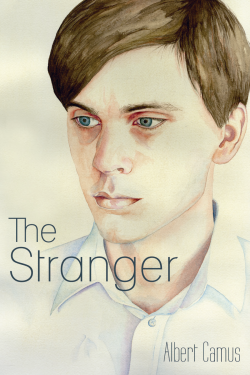
I started reading The Stranger on a recommendation. A guy told me the main character was a bit like me. Having read the book there is only one question I want to ask: How did Albert Camus know about me in 1942?

Joke aside, this a rather short book detailing a bit of the life of a Frenchman that doesn't feel much, is a rational person and doesn't believe in God. Therefore everybody around him thought him a stranger, hence the title of the book. Camus has a way of writing this in the first person, but in a way that seems both introvert and totally outside. The character describes everything he sees in neutral terms, proving he is both very observant and completely indifferent. When other people talk, he quotes them, when he describes himself talking, the character is summarising to the minimum, with no quotes, giving the impression he is a stranger to himself, hence the title of the book.

In the end, it felt like the last part of the movie The Mist. The same irrational fear of the different, coming from a shapeless mass of mindless drones, blindly destroying everything. In my view, the character manages to maintain his decency by rejecting the smallest gesture of resistance. But what do I know?

Would I recommend the book? It certainly teaches the reader something. It describes a way of thinking and of being that is different from most people. It explores several philosophical schools of thought, but you wouldn't know about it unless you read Wikipedia :). It is short enough to not bother anyone, though. Why wouldn't you read it?

and has 0 comments
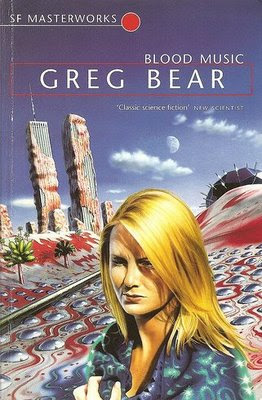
Greg Bear is the type of writer that I just have to love: he writes hard SciFi, but easy to read, he doesn't bullshit the reader with too much technobabble and, even if his writing is by no means simplistic, he doesn't bore you with how some person or another feels unless it propels the subject forward. Blood Music is also of a subgenre that I love: global pandemic, so I have to also love the book. So take that into account when you read my review.

The book starts with a preposterous idea: that cells can become intelligent. A brilliant scientist, but one that has always cut corners to get around, discovers this almost by accident and... well... cuts a few corners. The result is something that feels like John Saul's The God Project, but soon leaves it and reaches for the stratosphere. The end is typical Greg Bear, astounding and megalomaniac.

Blood Music has some flaws. One of them is that it is really a very short book, an extension of the original 1983 short story that won the Nebula. The other is that it is written in 1983 (similar to The God Project) and so the science background is both grandiose and a bit obsolete. But it is a good book and one that ponders on the significance of identity, thought, society and ultimately: the essence of reality. I've read it in about three days, so you have no possible excuse for not trying it.

and has 1 comment
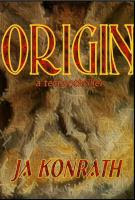
I was in the mood for horror, something really disturbing and hopefully on the sci-fi side, and so I went scouring the net for good horror books. Origin, by J.A. Konrath, was suggested by some guy or another, so I started reading it.

The problem is that the book is not much more than an easy thriller. The writing doesn't suck, but neither does it shine; the subject is intriguing, but treated in a screenplay fashion, with not much depth and only a few characters; the book is easy to read and really short; the plot has numerous holes in it. But worst of all, it doesn't really scare! While some of the scenes were - let's say - gory, they were not horror, but rather expected consequences of previous actions.

What is it about? The United States government (who else, tsk, tsk, tsk) has found a strange sarcophagus while excavating the Panama canal. For a century the secret is kept and the subject examined in a specially built facility underground. In the sarcophagus is a massive creature with red skin, hooves, horns and wings. After 100 years of slumber, it awakens. What is it? A devil, THE devil, an alien, a strange prehistoric creature? You will have to read the book in order to get an answer to that question.

Bottom line: I read it in less than a week, didn't hate it, didn't love it, it was good for passing the time, but I would not recommend it for anything but a vacation, to read on the way or in other boring moments.

and has 0 comments
Another song that I've been listening obsessively for the last day or two. I am fascinated by the mouth on that girl. So filthy the words, so beautiful a smile, so machinegun the speed. Not something that I would have associated with Manhattan , either. Here is the video, I will paste the lyrics below, because you may not understand them from the song alone :) You may also understand why at first I didn't believe it was on a TV music station, where I heard it the first time.


Hey, I can be the answer
I’m ready to dance when the vamp up
And when I hit that dip, get your camera
You could see I been that bitch since the Pamper
And that I am that young sis, the beacon
The bitch who wants to compete and
I could freak a 'fit, that pump with the peep and
You know what your bitch become when her weave in
I just wanna sip that punch with your peeps and
Sit in that lunch if you're treatin'
Kick it with ya bitch who come from Parisian
She know where I get mine from, and the season
Now she wanna lick my plum in the evening
And fit that ton-tongue d-deep in
I guess that cunt getting eaten (4x)

I was in the 212
On the uptown A, nigga you know what’s up or don’t you?
Word to who made ya
I’m a rude bitch, nigga, what are you made up of?
I’m-a eat ya food up, boo
I could bust your eight, I’m-a do one too, fuck ya gon' do?
I want you to make bucks, I’m a look-right nigga, bet ya do want to fuck…
Fuck him like ya do want to cum
You're gay to get discovered in my two-one-deuce
Cock-a-licking in the water by the blue bayou
Caught the warm goo in your doo-rag too, son?
Nigga you’re a Kool-Aid dude
Plus your bitch might lick it, wonder who let you come to one-two
With ya doo-doo crew son… fuck are you into, huh?
Niggas better oooh-run-run
You could get shot, homie, if ya do want to
Put ya guns up, tell your crew don’t front
I’m a hoodlum nigga, you know you were too once
Bitch I’m 'bout to blew up too
I’m the one today, I’m the new shit, boo, young Rapunzel
Who are you, bitch, new lunch?
I’m-a ruin you, cunt (4x)

Ayo (ayo), I heard you're riding with the same tall, tall tale
Telling them you made some (made some)
Saying you're grinding but you ain't going nowhere
Why you procrastinate girl? (-nate girl)
You got a lot, but you just waste all yourself
They'll forget your name soon (name soon)
And won't nobody be to blame but yourself, yeah

What you gon' do when I appear?
W-when-when I premiere?
Bitch, the end of your lives are near
This shit been mine, mine (x2)

Bitch, I’m in the 212
With the fifth cocked nigga, its the two-one-zoo
Fuck you gon' do, when your goon sprayed up?
Bet his bitch won't get him, betcha you won't do much
See, even if you do want to bust
Your bitch’ll get you cut and touch you crew up too, Pop
You're playing with your butter like your boo won’t chew cock
The gun, too -- where you do eat poon, hon?
I’m fucking with you, cutie-q
What’s your dick like homie, what are you into, what’s the run, dude?
Where do you wake up? Tell your bitch keep hating, I’m the new one too, huh?
See, I remember you when you were
The young new face, but you do like to slumber, don’t you?
Now your boo up too, hon
I'm-a ruin you, cunt

What you gon' do when I appear?
W-when-when I premiere?
Bitch, the end of your lives are near
This shit been mine, mine (x2)


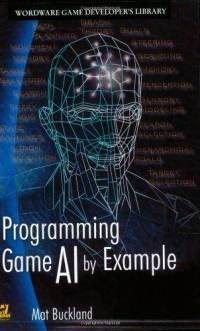
Programming Game AI by Example is one of those books that would have changed my life had I had read them when I was 15. Mat Buckland is taking a really high tech portion of game making and turning it into child's play. With source code!

From the very beginning we are being told that AI in games is different from what we would normally associate with Artificial Intelligence. AI in games is the thing that makes game agents look smart, but let the user enjoy the game the most. In other words, something that seems smart, but is just stupid enough for you to continue playing.

The book is comprised of ten chapters, heavy with code, but very well structured. The main tool in use are Finite State Machines, but we first get a mechanics physics lecture in chapter 1 where we learn what a vector is and how to normalize it and how to use this in the game physics. Moving to chapter 2, we learn what a state machine is and how to optimize memory by making each one a singleton, how to compose them and why more exciting aspects of artificial intelligence, like say neural networks, are not used more in games. We delve further into methods to optimize what we have learned to make it practical: prioritized dithering, partitioning, BSP, quad and oct trees, fuzzy-Q logic, cell space partitioning, all with code examples, in chapter 3. Chapter 5 is reserved for graphs, Dijkstra, A* and such. Chapter 6 goes into integrating Lua into your games, as a good tool to define and tweak the innards of your game before compiling it all for performance into a single code base. Raven, the example game engine, is detailed in chapter 7. Path planning is described in chapter 8, complete with many optimizations and tricks to make an algorithmic movement of units look natural and smart. Chapter 9 is about goal driven agent behaviour, where we learn how to make an agent define goals and act upon those goals. The composite pattern is suggested as a good solution for goals within goals. We end with a very interesting chapter about fuzzy logic. The basis of this is to fuzzify a situation, infer a behaviour, then defuzzify into a usable algorithmic value.

The bottom line is that this is a very easy book to read, explaining matter-of-factly how to easily create the intelligence in games like Fifa or Counter Strike. The code examples are extensive, but not necessary to understand the gist of things. At the end, it is both a fascinating and intriguing read as well as a good reference book for when you actually need this stuff.

I end this review with a quote from Dijkstra that was also mentioned in the book: The question of whether Machines Can Think... is about as relevant as the question of whether Submarines Can Swim. Very nice book and a recommended read.

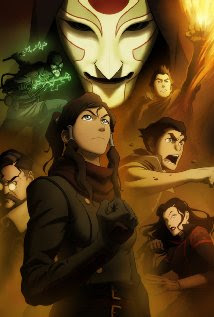
I loved the first Avatar animated series. It was deep, funny and yet innocent. A perfect kid show, but one in which an adult could find finer underlying levels of understanding. So it is no wonder that I eagerly awaited the release of Legend of Korra.

Now, that the first season is over, I can have an opinion on it. The show is not about a little kid anymore, it's about a teenager avatar. She, for she is a female, lives in a technological steampunkish world, something that is pretty hard to understand, considering she is the granddaughter of Ang, the hero of the first series, and it all happens merely 70 years afterwards. The innocence of childhood is replaced by the impetuosity of teen age, complete with mood swings, romantic feelings and a strong false sense of infallibility. The elemental countries are now united, so the only possible threat can come from a terrorist organization. There are moments of real fun, but not that many.

Bottom line: it's a completely different show! While in the first Avatar one could find strong moral values underlying what the characters did and the viewer would watch the show waiting to see what would Ang do next in the face of overwhelming adversity, now the focus is on what the avatar girl is feeling when she is not the center of attention and how she gets angry and motivated to use power to solve things. Not something terribly surprising in an American show, but really disturbing in a sequel to such beautiful a series.

So, while the show is nicely animated, the world interesting and the story passable, the overwhelming feeling I get is disappointment. I really do hope something will come out of the next seasons, which I will watch religiously, but let's face it: I do it for Ang.