and has 1 comment
My blog becomes boring as I fly through the Wheel of Time series and it seems this is all I write about. The truth is that the feeling that started creeping in from books four or five, the "let's get it over with" feeling, has become stronger and undeniable. I don't want to stop reading the series, but I want to finish it soon, so I get to something that is truly interesting.

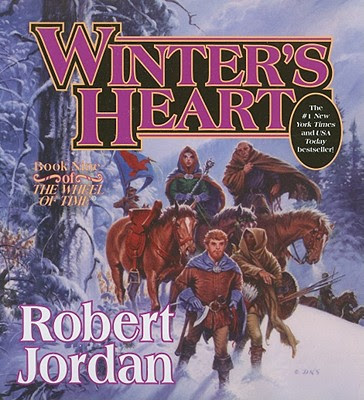
Winter's Heart is somewhat fractured. It continues where Path of Daggers left it and again it ends without a definite book boundary, just like a simple episode from a series. There is a rather important situation right at the end of the book, but it is underwritten, leaking important knowledge matter-of-factly and barely describing what should have been glorious fights with the One Power.

My impressions: Mat's storyline becomes intriguing, after a bit of utter boredom. Perin's story becomes ridiculous, with choices no sane man would make, not to mention women, and the obnoxious Aiel again getting a foothold in the plot. It has reached a point for me where any mention of Aiel just rubs me the wrong way. Rand is trying to make his enemies unsure of his plans, therefore he acts erratically, but that means he doesn't really do anything, until the end of the book. The girls are all doing whatever they feel like it, without coordinating with the boys, but still assuming they don't need to. The worst are the "evil ones" which seem to have fallen asleep. Fain tries to kill Rand, but not when he has him alone somewhere, only when he can "lure" him into a trap, together with all his friends.

Some ideas do come up. One is that Shai'tan is nothing more than a force of evil, not unlike Sauron, nothing corporeal or even conscious. All the evil in the book is done by people "doing the Great Lord's work" and their minions. The idea that the Dark One is imprisoned and that is why his actions make no sense is moot. Also, it seems that the Chosen are being reincarnated almost as soon as they die, only in other bodies. They call themselves differently, for some reason, but they possess the power and knowledge they had before death. They fear death, also, which make no sense at all. Robert Jordan's talent here is to make the evil side act stupidly, but without letting the reader feel so, and he manages it pretty well. Too bad I am more of a rational person.

I really like the idea that the One Power (which was always two, one male, one female) has an evil equivalent (the True Power - who comes up with these names?). Being of a Western origin, it is likely Robert Jordan will feel the need to unite all of these powers under "one God", so interesting interactions and hybrids might appear later. A tantalizing hint that Moiraine might be alive is also presented, when a reincarnation of Lanfear appears. Now that more annoying characters have popped up, I almost miss her, not to mention Lanfear herself, which is my favourite evil insane female character in the book :)

and has 1 comment
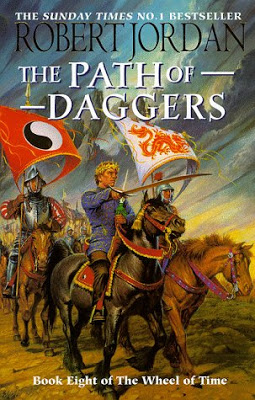
The one word that comes into mind when I think of the book is "frustrating". Having abandoned any semblance of independence between the books, Robert Jordan continues in The Path of Daggers many of the story arches began in A Crown of Swords and I don't know if he ends any. All the characters are acting like proud chickens, lacking any thought. They are emotional, weak, playing games when important issues are at stakes, taking serious offence from irrelevant words. I am sick of people "educating" others via beating, switching, shaming, pompous posturing, power plays and torture. The fate of the world is at stake and each and every one of the heroes of the story act like they still have other options. And while they are disgusted by people doing that very thing, but not seeing it in themselves.

At this point I am left with no other choice than to "watch" the story unfolding like on TV, because I feel no connection with it whatsoever. My wife asked me which of the characters in the book I most identify with. And I couldn't think of any. Even Shai'Tan doesn't make any sense at all. I've already started Winter's Heart and it continues in the same way.

and has 0 comments
The seventh book of the Wheel of Time series is a direct continuation of the sixth. I was saying in a previous post that book six, Lord of Chaos, was long and it doesn't even have a complete ending; A Crown of Swords overlaps Lord of Chaos a little, then opens up some other doors and doesn't close them either. Either this is the pattern (pun not intended) of the next books, or this is actually a weave (ok, now I was doing it on purpose :) ) of at least three books that are strongly coupled to each other.

A Crown of Swords is back to a size closer to the average of the other books, but since it is so connected to the books before and after, it doesn't really matter. There is a lot happening and some of it is captivating. I can't really empathize with most of the characters, though, except maybe Mat, and he is very present in this book. A new evil type of darkspawn appears, along with an advanced type of Myrddraal. The girls are hunting ter'angreal, the Seanchan are stirring again and a new battle against Forsaken is close. Also an Aes Sedai hero is approaching Rand and completely dissing him. Fun stuff!

and has 0 comments

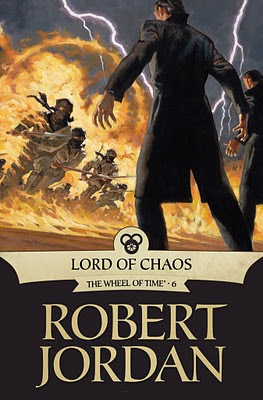
Lord of Chaos was a long book to read. In size, it was as long as Shadow Rising, the longest book in the series so far, but it felt more packed. After all, Rand and Egwene can use portals and they go where the action goes, the Tower is divided, the Aiel are divided, a force of channelling men is created, Cairhien and Tear soldiers fight along Rand, there is action in Ebou Dar, Tear, Cairhien, Salidar, Andor, Two Rivers, Amadicia, The Forsaken are executing a plan of the Dark Lord and so on and so on.

There is a problem with consistency again, at least as I see it. If this was a strategy game, imagine more players playing in the same team, but each of them doing whatever they feel like. They are all friends, they even have one central character they can rally with, but they continue to do things their way. If the other team would have even a modicum of coordination, they would easily win. Also, the series has succumbed to levelitis, the disease that causes all main characters in a story to level up continuously, until it becomes unmaintainable. Rand and Eqwene can Travel or enter Tel'aran'rhiod in the flesh, Elayne can make ter'angreal, Nynaeve can heal stilling and gentling, Mat has the memories of countless heroes and has a talisman against saidar, Perrin is a lord, Loial can fight, Min can read auras and fight with knives, etc. It is getting so grand, that I fear for the books to come.

Even so, I've enjoyed the book and at the end I could barely stop reading to see where all the tension accumulated in the last hundred pages would explode, and how. The grandness and action packing of the book also led to a kind of split, where the stories started now have not ended yet and I must continue to read the series to see what is going to happen. The name of the book is also strange, as the Lord of Chaos is somehow related to the Dark One, but we don't really learn who he is; only hints are left here and there. Finally, Shai'tan seems to be more than just the cardboard evil destroyer of life and gains some complexity.

Sigh! There are 14 books in the series, I have just started the 7th and they seem to be growing in size as I go along... this is going to take a while.

and has 2 comments

I am already inside the story and it is getting harder and harder to analyse individual books. All I can say is that, again, there are a lot of incredibly condescending and arrogant people, mostly women, which are presented as indomitable based on looks or appearance or prestige, yet with not a shred of usefulness. I was reading this book and I was finding myself daydreaming of what I would say to such an annoying individual. What I find even more disturbing is that a lot of times the superiority of one's opinion was demonstrated via violence. Educational violence, mind you, switching, bottom beatings or pinches, meaningless and hard chores, but still violence and hardly acceptable to me.

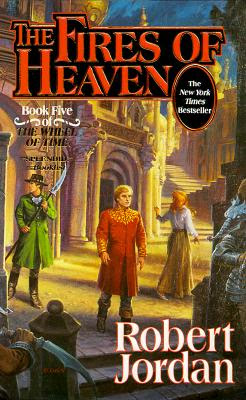
Rand and Mat go together in The Fires of Heaven, but their contact is almost not existent and Mat is always trying to get away. What happened to their long time friendship? It evaporated in Jordan's writings. Perrin has saved the Two Rivers, but then married and stayed there, as if the world was saved and there was nothing to be done about it. Eqwene is with Rand as well, but more Aes Sedai and more arrogant by the minute, her relationship with Rand abandoned since subjected to the conscriptionary methods of both Aes Sedai and Wise Ones. A horrid character, if you ask me. Morraine is even more mysterious and useless as in the previous books, except for the end, where she does something heroic, but kind of dumb. Rand is getting "hard", but still suffers the people around him as he could do nothing about them. A prisoner of his own small village upbringing, he seems a sad sorry character, as remote from heroism as a dung beetle is from a professional dancer.

Interestingly enough, I found the Elayne and Nynaeve story arch a lot more satisfying. Complex, reasonable and thrilling. That until they voluntarily return to the Aes Sedai, where they have to again suffer all the humiliations an Accepted is supposed to suffer to gain "character". A new female Forsaken appears, Moghedien, but not nearly as interesting as Lanfear, who is present in this book, but terribly inconsistent. The ending of the book also annoyed the hell out of me, since I believe her outburst was completely out of character.

All and all, as interesting and captivating as the others in the Wheel of Time series, but suffering from a kind of character sublimation, in which the story is being carried by people that don't act like themselves. Book 6 is on the way.

and has 0 comments
All this opposition to these new American laws that are being discussed SOPA and PIPA has become a kind of spam that covers the real issue of what these laws are all about. Certainly there is nothing in the title that says anything remotely useful. Here is a TED talk lasting only 13 minutes that explains what is what:

>

Also, you might be interested in one of our own Romanian comics, Pidjin, who are explaining it nicely in graphical form. They are very funny and inspired in general, but the SOPA bit was brilliant.

and has 0 comments
It seems that Robert Jordan is balancing the odd books of the Wheel of Time series series with the even ones. The first and the third books were kind of black and white, little grey in between, all good characters fighting the evil. Now, the second and the fourth seem to be more ambivalent. Does that mean that the fifth will be again a bipolar epic battle? I'm ready to find out! [grin]

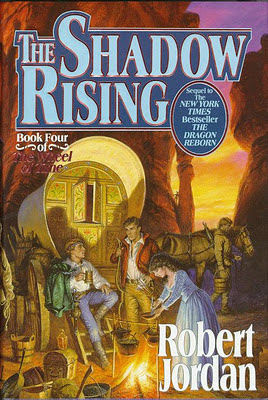
In The Shadow Rising there are four different main stories that have little to do with one another, all happening simultaneously. There is the Rand arch, going to Rhuidean to fulfil the prophecies, accompanied by Mat, Eqwene, Moraine and the Aiel; there is Perrin, going back to Two Rivers to protect it from Ordeith, Whitecloaks and hordes of Trollocs; Elayne and Nynaeve are hunting Black Ajah; finally, the White Tower itself has some major problems.

The book was certainly entertaining, although not particularly deep. A lot of complex characters are relegated to doing cliché work, like Thom, for example. A large part of the book is focused on Perrin, while Mat is all but ignored. My favourite character Lanfear appears from time to time, too. Rand does weird things, making us wonder if he has lost his mind or just has a plan, but neither his companion nor the readers know what that might be. I liked the Egeanin bit of the girls story, but I can't tell you more for fear of spoiling it. Some really flashy and important battles are being carried out by different characters, although they are more literary show than substance, as battles go.

All in all, a reasonable continuation of the series. I think I am safe by now in saying that Wheel of Time is addressed to adolescents and will probably not evolve to something further to the end of the saga. Still fun, though.

and has 0 comments

I've previously written about Pioneer One, the show that is produced almost entirely from donations and is distributed free on the Internet. Its first season contains 6 episodes and I have just finished watching it. As I was saying before, the series is cheap as dirt, but people have managed to use an intriguing story and ingenuity to make a decent production that I enjoyed watching.

Not only I love the idea of these "free" movies, where people actually make the effort to pay only if they liked them (and are that kind of people), but I see it as a seed for greater things. On their site, the people at Pioneer One are promising a second season, this time financed by sponsors that would have liked the first. It is an interesting hybrid that is being born: a crowd-sourced first season, that people must like or it wouldn't happen in the first place, and a more classical method of financing the rest, but based on that first bit of work. No one will escalate it to intergalactic space wars with lots of special effects. Like a film production with a soul.

I am looking forward to what they will do next, both heroes of the series and makers, heroes in their own way.

Update February 2016: Well, They have released a "webisode", which means they didn't quite manage to get the sponsors or something else happened. Just in case they do anything, you might want to subscribe to the Pioneer One YouTube channel.

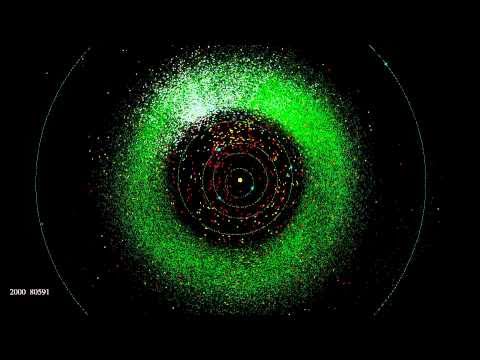
I have been interested in the asteroids in the Solar system lately and, while perusing the vast amount of data that is now on the Internet on the subject, I've stumbled upon a video of the number of asteroids humans have discovered in the last 30 years (1980-2010). It is a simple bird's eye view of the Solar system, with the planets and the small objects we knew at the time to exist, together with a highlighted view of the objects we were seeing from the Earth at any given moment.

You should watch the video full screen and a large resolution, as the objects are pretty dim. If you only see the highlighted object, you should increase your video brightness or gamma settings. Enjoy!


The video is from Scott Manley's YouTube page, and there are more interesting asteroid videos there as well. I urge you to see them. The ones I enjoyed best I will include below.

Density Of Asteroids in the Orbital Plane of the Solar System


Asteroids In Resonance With Jupiter


Asteroid Belt - Edge On View


and has 0 comments
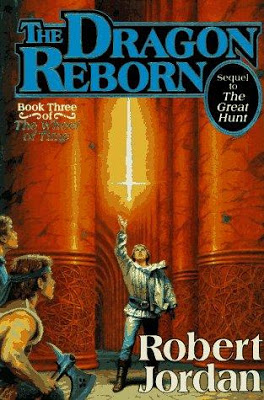
The Dragon Reborn relapses into the problems of the first book in the Wheel of Time series: there are good or bad characters, light and dark and the only true unknown (and most exciting as well) is Lanfear. The rest of the book is how all the characters level up dramatically to the point that none of them can pretend to cling to their small village roots. Rand is the Dragon, Perrin is a wolf, Mat is the reincarnation of a Manetheren hero, the girls are the most powerful girl power users in centuries, etc. If anything, the losers of this book are Loial and the Aes Sedai with their Warders, as it seems none of their long life, experience and training matter in the face of ta'veren-ness.

That doesn't mean that the book is not interesting, quite the opposite, it is certainly more epic, although in the same way the other two were (I am beginning to see a Pattern, heh heh) as the pressure builds and builds towards an ending that feels rushed. It's like sex after too much foreplay: is that it?

The bottom line is that Robert Jordan's series has captured my imagination, with all its clichés and great prophecies and noble heroes. I did hope for something more complex, but then again, life is not like a book and there are level-downs as well. There is still a chance the next book will be as intelligent as it is flamboyant, though.

and has 0 comments
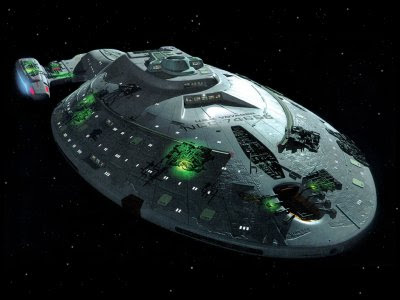
I've finished watching the seven seasons of Star Trek: Voyager and, even if I enjoyed watching it, I also think it was the series with the most potential lost from all of them.

First of all, the show should have been called Star Trek Condescension. Each Star Trek series before it had some obnoxious characters, like Bones in The Original Series, even if he was saved by the clever interactions with his counterpart, Spock, or like Deanna Troi in Next Generation, intrusive and opinionated about just about everything that did not concern her, or like Kira Neris, who always had some cause to fight in the detriment of all her other colleagues on Deep Space 9. It was OK, it part of the concept. Voyager has broken that rule, making just about everybody as annoying as possible.

Top of the list: Captain Janeway, who was not only acting like the headmistress of a high school, placed there by divine powers to have children under her care and control, but who was also a complete hypocrite, changing her views whenever it suited her, but quoting larger than life "directives" whenever she wanted out of something. For all her talk of saving lives, if the show was reality, she would have killed her crew numerous times and would have insured just about every major force in the quadrant was an enemy of the Federation. And the worse part is that her acting was perfect: from the condescending tone of her voice to the raised eyebrows, from the hand on her hip to the dismissive smile, her body language was more obnoxious than anything she could have said.

Second in command Chakotay, a man of native-American origins, would have no problem breaking any rule when his Maki training would surface, only to justify anything by either invoking his spiritual ancestors or spouting truisms while fully inhaling before each sentence. While Janeway's condescension was authoritative, Chakotay's was always thuggish, but just as strong and annoying as his captain's. Also, he was making mistakes almost every time it didn't involve physical activity. Not the best choice for a second in comand.

Neelix deserves a special place in the annals of obnoxiousness, as a rodent like alien who comes on board as the lover of this pixie like beautiful blonde. After suffering more than a season rude and abusive bouts of jealousy from him, we spend the rest watching him intrude in everybody's personal lives from his self appointed position of "moral officer" and later of "ambassador". Only in the last season a Q is fusing his jaws and lips and removes his vocal cords, a humanitarian move who only lasted till a few minutes later. Blessed be the silence, though.

There are more, from the loud mouthed doctor who is "evolving" from very rude to intrusive and almost destroys the ship twice with all the good intentions to the duo B'elanna Torres and Tom Paris, who act so superior towards anybody not like them that they would have undoubtedly made the alpha couple in a high school drama.

A good thing about the series is the design. All the technology is consistent in aspect and apparent functionality from the start to the end of the series. Considering Voyager was produced during amazing technological advancements in television and computers, it was probably an effort not many noticed. The human component, so easily removable via computers and nanotechnology, was preserved during the entire length of the series, maintaining that theatrical feel and enforcing the idea that the sci-fi in the series was just a prop for some larger ideas. Unfortunately, the ideas was not that large, and were mostly human centric and ridiculously optimistic.

About the plot, the show is about a Federation starship stranded in the Delta Quadrant, seventy thousand light years from Earth. The way people travel is the most inconsistent part of the series, as they are always struggling to get home, while the same aliens are attacking recurrently, even with less advanced technology. How could they "ambush" Voyager, if they were left behind?

The holodeck and the holographic doctor were used extensively as a plot crutch, whenever they were out of ideas. Meetings with the Borg are common, even if the results are mind baffling. One of the most disgusting things in the series is the treatment of Seven of Nine, a Borg that is being coerced back to individuality despite numerous declarations that it wants to return to the Collective. But Janeway knows best and all the list of annoying characters above proceed thereafter to piss on the Borg heritage of Seven and insist on developing her "humanity". If Voyager would be watched by the people described in the show, it would undoubtedly be considered crass human propaganda for the Federation.

And still, for all the reliance on Borgs to move the plot on, the technological side of the equation was repeatedly ignored. Seven is part Borg and will remain so for the rest of the series, including nanoprobes in her blood. Yet she does not attempt to assimilate anyone, including enemies, when it would have been the best way of solving some of the problems. Borg technology is added to Voyager, but most often reluctantly and only temporary. Seven never develops cybernetic tools for herself, even after her implants save the ship several times. Also the Borg Collective is presented as a mindless community of interconnected people, but at the end a Queen of the Borg is revealed, who has total control and presents a target and a persistent enemy.

Bottom line, for a technological person as myself, I was almost attracted more to the Borg model than the Federation one. While the words "democracy", "freedom" and "openness" were spouted at every occasion, true freedom of thought was only tolerated on Voyager when the captain agreed. The Borg at least used the individual as a conduit for the general thought. The morality lessons in the series were simplistic and antiquated. Voyager, with the idea of a ship stranded somewhere, with problems that needed solutions with limited resources and lots of ingenuity, could have been a series to open minds. Instead, it force fed US concepts from the 60's.
and has 0 comments

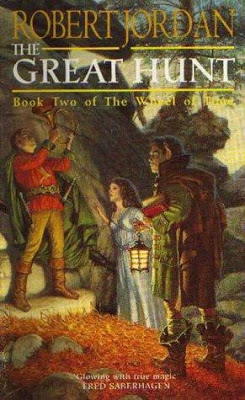
I have to admit, the quality has increased dramatically in both writing and storyline in this second part of the Wheel of Time series. Robert Jordan's The Great Hunt follows our heroes in their quest to heal Mat, deliver the Horn of Valere and escape the endless machinations of the Aes Sedai.

I was saying in the review of the first book, The Eye of the World, that the story was ridiculously black and white, reminiscent of Lord of the Rings. The Great Hunt features good and evil Aes Sedai, sympathetic Darkfriends, political Cairhienians that see every action (or lack thereof) as a move in The Great Game of lords and not less than three new major threats, not counting the Black Aes Sedai, as well as parallel worlds, resurrected heroes and epic battles. So there is a good range of shades of grey, washing away the simplicity with which the series started. The characters gain volume, developing in their own unique ways.

There are some issues, though. Rand is exhibiting wonderful skill and ability exactly when needed, being pretty much clueless most of the time. Women again appear rather one sided: proud, intelligent, manipulative and always in some way of authority over men. The "The wheel spins as the wheel wills" quote is used way too much and the blatant logical hole ignored: if it does, then no one needs to get involved in anything, especially the Aes Sedai. Nynaeve find a new strength and acts more like a Wisdom and less like a scared little girl.

So I am caught up in this. Too interested to start reading the tech book I was planning and too much work at the office to really feel the need to. Let's see how the next book in the series will be.

and has 0 comments
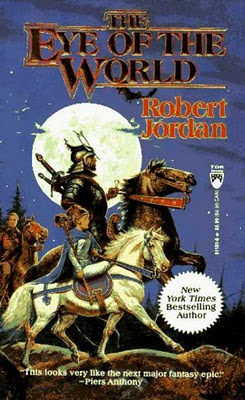
The Eye of the World is the first book in the series called The Wheel of Time, by Robert Jordan. Written in 1983, it is very similar to Lord of the Rings. It features a complex world of nations and races with their own languages and cool sounding names, a battle of good light versus evil dark that is so ridiculously polarized that at first I thought I couldn't finish the book, a party of different people in which the main character is a poor country sheppard boy, a quest that has the goal of saving the world via a long trek of personal transformation.

Actually, if I think about it, it seems almost entirely inspired by Lord of the Rings, with none of the innovations that appeared since playing any effect except maybe The Chronicles of Thomas Covenant the Unbeliever, when describing the Blight. Something that is clearly different in the book is the role of women.

While Tolkien had them placed high on a pedestal, queens and princesses that were supposed to inspire men but not be touched, Jordan presents them as important members of the party, with Moraine, the "wizard", holding most of the authority. Actually, it goes further than that, giving all women characters an almost indomitable ability to influence men. Only one female in the entire book is evil, and that for a very brief period of time, and none of them are weak in any way. It doesn't even matter much that The One Power has two sides, one female and one male, and that the male is tainted by The Dark One. Even if they would have magical power, men are doomed to be ruled by women in The Eye of the World and probably the rest of the books.

The evil Shai'tan is a dark entity with burning eyes and eternal rage, imprisoned yet powerful, corrupting everything he touches, while the power that opposes him is white pure light that heals, purifies and avenges. The only shred of ambiguity comes in the shape of The Children of the Light, a warrior sect dedicated to fight evil, but that are nothing more than pompous gang members that define evil as anything they don't like.

All and all the book was pleasant enough and, being December, I plan on reading at least the next book in the series before I start with a technical one. However, it doesn't come close to most of the books I've read recently. The simple design and clear inspiration is probably the reason why they want to adapt the story to television, now that the likes of Game of Thrones have shown the model successful. If the quality of the books does not improve in time, it may be so that it would be more effective to wait for the films instead of reading the book. Then again, I will make up my mind after I've read more. I have hope.

and has 0 comments
Long time since I've posted a song. I heard this one at a lunch with a friend and then I dug up this rare video of the last performance of Shakespeare's Sister before they split up. Enjoy!


Here is the original video of the song:

and has 0 comments

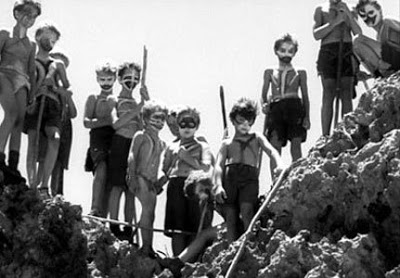
This book touches a very uncomfortable subject for me: the mindless, visceral hive mind of the crowd. There is nothing more horrible, I find, that being powerless in front of a mob of people united by only their stupidity and fear. Lord of the Flies is the archetypal book about this subject. It tells the story of a bunch of British kids stranded on a small island without any adult supervision. They create a parody of human society which ultimately fails horribly towards the end.

The book is short, but to the point. Sections of it are almost unbearable to read, not because it features monsters or supernatural creatures, but because you feel deep inside that it is the truth, that these things happen and that they do because of something deep inside each of us.

The only failing of the book, I feel, is that Jack and Roger are portrayed as classical psychopaths and it is clear from the beginning that one cannot empathise with them. A slightly longer story that would have made the effort to make these characters slightly likeable would have had an even deeper impact. In that case, I fear, the book would have become completely unbearable. People need their illusions about the society around them; shattering them completely would not do.

This book is a must read for any student of human psychology and one of the best books to reference at parties to make you look smarter than you are :-) I've actually read the book because I was doing that too much, but had only seen the movie. I wonder if I should get other works from William Golding, since I liked this one so much.