As I was blogging before, RedGate are assholes. They bought Reflector, promised to keep it free, then asked money for it. But every crisis can be turned into an opportunity. JetBrains promised a free decompiler tool and they have kept their word as they have released an early build. A total news to me, but not really a surprise, other software companies decided to build their own version in order to boost their visibility in the developer world. Telerik, for example, has just released JustDecompile, beta version.

It is no secret that JetBrains is a company that I respect a lot, as they made ReSharper, the coolest tool I've ever had the pleasure to work with, but I will try to be as unbiased as possible in comparing the options. I have tried dotPeek on WPF's PresentationFramework.dll from the .NET framework 4.0, as I often need to check the sources in order to understand functionality or bugs.

As a footnote, Reflector, just before it went commercial, could not decompile some of the code there. Not only it did not decompile it, but it presented empty methods like that was all there was in the code, with no warnings or errors or explicative comments. So, even if free, I bet Reflector would have sucked in the end, after getting into the money grabbing hands of RedGate.

dotPeek has seen and decompiled the code that Reflector did not. Also, I have to say that similar functionality like in ReSharper, finding usages, going to declaration, etc are making dotPeek a very nice tool to work with. What I did not quite like is that it doesn't have yet the functionality to save the sources to text files. But I am sure this is just a detail that was not implemented yet. Hopefully, they will provide a rich plugin model like old Reflector did.

Unfortunately, to download JustDecompile, they need you to have a Telerik login in order to download, which, as everyone knows, simply sucks. No one likes a registration form, folks! Especially one that presents you with wonderful prechecked checkboxes for permission for Telerik to send you all kind of stupid promotions and newsletters. Also, the download is of a .msi file. Most developers like to see what they are installing and preferably just copy it from a file archive. Running the .msi took forever, including the mandatory 100% CPU utilization bit that I will never understand in installation products. (coming from the .NET runtime optimization service, mscorsvw, called by ngen) But that's just the delivery system. Let's check out the actual thing.

JustDecompile starts reasonably fast and it also has a nice look, being build with Telerik controls and what not. The decompilation is a bit weird at first, since it shows only the method names and for a second there I thought it was as bad as Reflector was, but then I noticed the Expand All Members button. The context menu is not nearly as useful as dotPeek's, but there are a lot of options in the top toolbar and the navigation via links is fast and intuitive. It also has no text saving options yet.

As the decompiled sources were, I noticed these differences:
  • JustDecompiler places inline member declarations in constructors, dotPeek shows it inline. It might not seem an important thing, but an internal class gains a weird public constructor in order to place the declaration there, instead of using the only internal constructor that the class had. It looks strange too as its last line is base(); which is not even legal.
  • dotPeek seems to want to cast everything in the source code. For example List list = (List) null;
  • JustDecompiler shows a Dictionary TryGetValue method with a ref parameter, dotPeek shows the correct out.
  • dotPeek creates really simple names for local scope variables like listand list1, JustDecompiler seems to create more meaningful names like attachedAnnotations
  • JustDecompiler shows a class internal as dotPeek shows it as internal abstract.
  • JustDecompiler seems to fail to decompile correctly indexer access.
  • JustDecompiler doesn't seem to handle explicit interface implementations.
  • JustDecompiler doesn't seem to decompile readonly fields.
  • JustDecompiler transforms a piece of code into an if with a return in it and then some other code, dotPeek decompiles it into an if/else.
  • JustDecompiler doesn't seem to handle Unicode characters. dotPeek correctly encodes them in source like "\x001B".
  • dotPeek seems to join nested ifs in a single one, as opposed to JustDecompiler.
  • JustDecompiler uses base. in order to access members coming from base classes, while dotPeek uses this.


I will stop here. I am sure there are many other differences. My conclusion is that dotPeek could do with the naming algorithm JustDecompiler seems to use for local scope variables, but in most other ways is superior to JustDecompiler for now. As both programs are in beta, this could quickly change. I do hope that healthy competition between these two products (and, why not, shady developer meetings in bars over tons of beer and pizza, in order to compare ideas intercompanies) will result in great products. My only wish is that one of these products would become open source, but as both use proprietary bits from commercial products, I doubt it will happen.

Have fun, devs!

Update 23 Feb 2012:
Spurred by a comment from Telerik, I again tried a (quick and dirty, mind you) comparison of the two .Net decompilation tools: JetBrains dotPeek and Telerik JustDecompile. Here are my impressions:

First of all, the Telerik tool has a really cute installer. I am certainly annoyed with the default Windows one and its weird error codes and inexplicable crashes. Now, that doesn't mean the Telerik installer does better in the error section, since I had none, but how could it not? The problem with the installation of JustDecompile is that it also tried to install (option checkboxes set by default) JustCode and JustTrace. The checkboxes themselves were something really custom, graphically, so I almost let them checked, since they looked as part of the background picture. If it weren't for my brain spam detector which went all red lights and alarm bells when seeing a really beautiful installer for a free tool, I might have installed the two applications.

Now for the decompilation itself. I was trying to see what the VisualBasic Strings.FormatNumber method contained. The results:
  • dotPeek showed xml documentation comments, JustDecompile did not
  • dotPeek showed default values for method parameters, JustDecompile did not
  • JustDecompile could decompile the source in C#, VB and IL, dotPeek did only C#
  • JustDecompile showed the source closer to the original source (I can say this because it also shows VB, which is probably the language in which Microsoft.VisualBasic was written), dotPeek shows an equivalent source, but heavily optimized, with things like ternary operators, inversions of if blocks and even removals of else sections if the if block can directly return from the method
  • There are some decorative attributes that dotPeek shows, while JustDecompile does not (like MethodImplAttribute)
  • dotPeek has a tabbed interface that allows the opening of more than a single file, JustDecompile has only a code view window
  • dotPeek shows the code of a class in a window, in order to see a method, it scrolls to where the method is; JustDecompile shows a class as a stub, one needs to click on a method to see the implementation of only that method in the code window


My conclusion remains that dotPeek is a lot more usable than JustDecompile. As a Resharper user, I can accept that I am biased, but one of the major functionalities of a .Net decompiler is to show you usable code. While I can take individual methods or properties with JustDecompile and paste them in my code, I can take entire classes with dotPeek, which makes me choose dotPeek for the moment, no matter all the other points above. Of course, if any of the two tools would give me a button that would allow me to take a dll and see it as a Visual Studio project, it would quickly rise to the top of my choices.

Update 26 Apr 2013:
I've again compared the two .Net decompilers. JustDecompile 1.404.2 versus dotPeek EAP 1.1.1.511. You might ask why I am comparing with the Early Access Program version. It is because JustDecompile now has the option to export the assembly to a Visual Studio project (yay!), but dotPeek only has this in the EAP version so far.
I have this to report:
Telerik's JustDecompile:
  • the installer is just as cute as before, only it is for a suite called DevCraft, of which one of the products is JustDecompile
  • something that seemed a bit careless is the "trial" keyword appearing in both download page and installer. If installing just JD, it is not trial
  • again the checkboxes for JustCode and JustTrace are checked by default, but at least they are more visible in the list of products in the suite
  • a Help Improve the Telerik Installer Privacy Policy checkbox checked by default appeared and it is not that visible
  • the same need to have an account to Telerik in order to download JD
  • when installing JD, it also installs the Telerik Control Panel a single place to download and manage Telerik products, which is not obvious from the installer
  • the install takes about two minutes on my computer to a total size of 31MB, including the control panel
  • if a class is in a multipart namespace like Net.Dns, it uses folders named Net.Dns if there is no class in the Net namespace
  • not everything goes smoothly, sometimes the decompiler throws exceptions that are then logged in the code as comments, with the request to mail to JustDecompilePublicFeedback@telerik.com
  • it creates the AssemblyInfo.cs file in a Properties folder, just like when creating a project
  • resolves string concatenation with string.Concat, rather than using the '+' operator as in the original code
  • resolves foreach loops into while(true) loops with breaks when a condition is met
  • uses private static methods in a class with the qualified class name
  • resolves inline variables, leaving the code readable
  • overall it has a nicer decompiled code structure than dotPeek
  • adds explicit default constructors to classes
  • places generic class constraint at the end of constraints list, generating an exception
  • it doesn't catch all reference assemblies, sometimes you have to manually add them to the list
  • decompiles enum values to integer in method optional parameters default values, generating compilation errors
  • decompiles default(T) to null in method optional parameters default values, generating compilation errors
  • decompiles class destructors to Finalize methods which are not valid, generating compilation errors
  • types of parameters in calls to base constructors are sometimes wrong
  • places calls to base/this constructors at the end of constructor code blocks, which of course does not work, when you place more complex code in the calls
  • doesn't understand cast to ValueType (which is somewhat obscure, I agree)
  • really fucks up expressions trees like FluentNHibernate mapping classes, but I hate NHibernate anyway
  • resolves if blocks with return in them to goto/label sometimes
  • resolves readonly fields instantiated from a constructor to a mess that uses a local variable to set the field (which is not valid)
  • doesn't resolve corectly a class name if it conflicts with the name of a local method or field
  • inlines constants (although I don't think they can solve this)
  • switch/case statements on Enum values sometimes gain weird extra case blocks
  • sometimes it uses safe casting with value types (x as bool)

JetBrain's dotPeek:
  • the EAP version has a standalone executable version which doesn't need installation
  • the whole install is really fast and installs around 46MB
  • as I said above, it does not have the Export to Project option until version 1.1
  • the decompilation process is slower than JustDecompile's
  • if a class is in a multipart namespace like Net.Dns, it uses a folder structure like Net/Dns
  • sometimes things don't go well and it marks this with // ISSUE: comments, describing the problem. Note: these are not code exceptions, but issues with the decompiled code
  • it inlines a lot of local variables, making the code more compact and less readable
  • weird casting of items in string concatenations
  • a tendency to strong typed casting, making the code less readable and generating compilation errors at times
  • the AssemblyInfo.cs file is not created in a Properties folder
  • when there are more classes in a single file, it creates a file for each, named as the original file, but prefixed with a number, instead of using the name of the class
  • it has an option to create the solution for the project as well
  • it creates types for anonymous types, and creates files with weird names for them, which are not really valid, screwing the project.
  • it has problems with base constructor calls and constructor inheritance
  • it has problems with out parameters, it makes a complete mess of them
  • tries to create a type for Linq IQueryable results, badly
  • it has problems with class names that are the same as names of namespaces (this is an issue of ReSharper as well, when it doesn't present the option to choose between a class name and a namespace name)
  • resolves while(method) to invalid for loops
  • it doesn't resolve corectly a class name if it conflicts with the name of a local method or field
  • problems with explicit interface implementations: ISomething a=new Something(); a.Method(); (it declares a as Something, not ISomething)
  • problems with decompiling linq method chains
  • I found a situation where it resolved Decimal.op_Increment(d) for 1+d
  • indirectly used assemblies are not added to the reference list
  • it sometimes creates weird local variables like local_0, which are not declared, so not valid
  • adds a weird [assembly: Extension] in the AssemblyInfo file, which is not valid
  • a lot of messed up bool values resolved as (object) (bool) (value ? 1 : 0), which doesn't even work
  • inlines constants (although I don't think they can solve this)
  • __Null local1 = null; - really?

After decompiling, solving the issues and compiling again an assembly in the project I am working on I got these sizes:
JustDecompile: 409088
dotPeek: 395776
The original: 396288

Of course, this is not really a scientific comparison between the two. I was excited by the implementation of Export to Project in both products and I focused mainly on that. The navigation between types and methods is vastly improved in JustDecompile and, to my chagrin, I have to admit that it may be easier and safer to use than dotPeek at this time. Good job, Telerik! Oh, and no, they have NOT paid me to do this research :-)

and has 0 comments

A bit late to the party, I finally found out that there was a mass escape from a Khanadahar prison. Apparently, Taliban forces have dug a tunnel from outside the Afghan prison and liberated about 500 of their peers. This is a blow to the local government and their western allies, the news say. I, however, cannot help but root a little for the underdog and think of the classic The Great Escape. In that film, allied prisoners of war were digging a tunnel to escape Nazis. Will they do a similar film about the Talibans now? I would. It would probably be both funny and tragic, navigating through all the incompetence, corruption, shrewdness and tension. As for the "western allies"... I would be a little proud. "Look, ma! They have grown so much, our children! They are not blowing themselves up, they are organising, planning for months in advance and finally building something. It's just a tunnel now, but I am so proud!".

and has 0 comments
Somehow I have managed to read the tenth and final book in Steven Erikson's Malazan Book of the Fallen series: The Crippled God. Almost a year ago I was saying "I doubt the tenth book will be able to satisfyingly end the story." and I have to agree with myself :)

The book continues where Dust of Dreams ended, but introduces even more characters, all amassing towards a grand finale. But is it grand? And is it, or should it be, a finale? I dare say no, but first a little bit about the content of the book.

The adjunct Tavore does for the entire book things that not even the characters understand. More than that, they follow her, all the time acknowledging that they don't know why. While this may work for short periods of time, it gets annoying and breaks one of the tenets of book writing: allow the reader to sympathize with the characters. How can you, if you don't understand what they are doing? Combine that with Erikson's style of beginning chapters without disclosing who the characters are and having to wait for a few paragraphs before using any names, and you get a book that is hard to enjoy without giving it all your attention. And when you do, people start sobbing and having "raw feelings" and understanding a world of pain from a single word and what not.

To summarize, I believe Erikson finally succumbed to the writer curse of trying to force the reader to think like him. In the end, the pleasure of understanding the situation explain by the author and filling in the blanks with your own imagination is replaced with a vast blank instead.

Then there are the tactical situations. After a rather interesting campaign in Letheras in Dust of Dreams we get a long pointless march that makes no sense whatsoever, problems created for no reason and bad solutions for them. The enemy, the Forkrul Assail, are nothing more than glorified Nazis, running around and spreading their own brand of justice, but having small and clichéd thoughts and not much in the way of actual power. They draw extra power from the heart of the Crippled God in order to boost their grand Akhrast Korvalain magic, but when it is time to unleash it, it pretty much duds, making the reader wonder what the hell happened. Also the military strategy makes no sense whatsoever, down to the individual battles. That could have slipped if Erikson wouldn't have slipped of how Tavore is the greatest strategist of all time. I won't bore you with the details, let's just say that there is much more sobbing than thinking in this book.

And now to return to the grand finale. Not only did I not understand much of it (maybe I am too dumb, who knows?) but it fizzled in comparison to most of the previous books. The battle was not that grandiose, the scheming something only a god would understand, the characters rather bland, the sobbing (did I mention it?), even the Malazan marine was boring in this book. I did enjoy it, but it all felt rushed and soulless. A lot less than I have imagined the ending of this great series to be.

The last qualm I have is with another writer trap: the desire to finish up in a clean way. It has to end with Apsalar in her village and the two meddling Shadow gods like the first book began. It had to end a lot of the pieces of stories sprinkled throughout the books. It had to save people that suffered and have couples reunited. This could have worked for a romantic comedy with werewolves, for example, but not for a series of books that never wasted time on finding boring beginnings and useless endings for its many threads.

The ending of the book betrayed the eight preceding books and some of Ian Cameron's. Perhaps the many voices of the characters always whispering in Steven Erikson's ears for twenty years have finally driven him mad. Or maybe he just got bored.

and has 0 comments
A while ago I was reporting the release of theStart's latest album, Ciao Baby, and the disappointing direction of their singing. I've revisited them and noticed that Aimee Echo, Jamie Miller and Chelsea Davis started a new band called Normandie which sounds very much like the old theStart, at least from the songs they've published on their MySpace site. Here is a clip from YouTube as well:

and has 0 comments
I said to myself "I'll just read a few passages of the book, just to relax a little, as I have a lot to do". Yeah right! I've started reading and I didn't stop until it was done. Stonewielder is a classic Malazan Empire book, but also bearing Esslemont's personal touch. There is the catastrophic magic battling immense godly power, while the ordinary soldier (the book focuses on heavies) carries on lead by the tragic commander, there are the weird twists from a perspective to another, the switches from a storyline to another, typical of a Malazan book, but also a bit less epicness and a lot more human failing, more characteristic to Esslemont than to Steven Erikson.

I have to say that I find the title to be a little off. The part of Greymane is quite insignificant until close to the end. A great book, nevertheless, and a nice prelude to The Crippled God, the tenth book (and laaast! :( ) in Steven Erikson's Malazan Book of the Fallen series, that I intend to read as soon as possible.

and has 0 comments
You have to excuse me, I've found this blog that I like, Ars Technica, and I can't seem to stop linking to stories there. This one is just funny: UbiSoft released their newest Assassin Creed game and, in a deluxe version, they included a bunch of extras, including the complete soundtrack for the game. However, when looking closer to the ID3 tags for the songs, it was discovered they were pirated versions, distributed on torrents after being taken from the collector's edition of the game.


There is a "theory" that piracy is enhanced by the fact that it is so easy to use pirated content and so damn annoying using the official, paid, version. So easy, it appears, that UbiSoft people found it more efficient to download the pirated version than to go through inner channels to get the songs. They essentially pirated themselves! If that doesn't make you smile a little, you must not be a geek :)

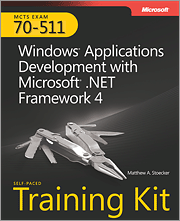
MCTS Self-Paced Training Kit (Exam 70-511): Windows Application Development with Microsoft .NET Framework 4 is a terrible book. It tries to cover the entire subject of Windows application development, so that means it must explain both Windows Forms and Windows Presentation Foundation concepts. Not only that, but it must do it in a consistent, comprehensible way, avoiding confusion between similar ideas that often overlap. It fails miserably on all counts, probably because it can't be done in a single book, but also because it is a jumbled mess that no one that is unfamiliar with the concepts there can actually learn from. I wonder, was poor Matthew Stoecker presented with the questions in the exam and asked to write a book to cover them? Because that would explain a lot. The 70-511 test itself it not much smarter.

The book starts with Chapter 1: Building a User Interface, in which it presents some basic WPF concepts like controls, resources, styles and triggers. If well written, this could have been a good start. It then continues with Chapter 2: Working with Events and Commands, containing stuff about events and commands, obviously, but then animations! So a novice at desktop applications now has to suddenly contend with animation. Maybe it was a slip up, so let's try Chapter 3: Adding and Managing Content, talking about brushes and the visual tree, even transformations, but then it goes into using MediaElement and MediaPlayer to play sounds and video.

Chapter 4: Windows Forms and Windows Forms Controls starts talking about Windows Forms, but in a completely new way and structure than the WPF part. It talks about modifying properties in Visual Studio, it describes the controls, one by one, with properties and all. It's like a completely new book. Chapter 5: Working with User-Defined Controls starts with Windows Forms, then it tries to explain Control Templates in WPF, then jumps back to user controls, this time in WPF.

The book switches to data in Chapter 6: Working with Data Binding, explaining the WPF Binding mechanisms including validation, and in Chapter 7: Configuring Data Binding it talks about various data sources and DataTemplates, also for WPF. Then it moves back to Windows Forms, Chapter 8: Working with Data Grids and Validating User Input, which starts talking about data bound controls in Windows Forms, but then it goes on and on about the DataGridView. It goes on by combining in a single subchapter Windows Forms validation and IDataErrorInfo in WPF.

Before you know it, in this whole confusing bunch of thrown facts, with no structure or plan, you go through Asynchronous Processing (using BackgroundWorker and delegates, but not Tasks!), Globalization and Localization (yeah, that is the important part) and integrating Windows Forms and WPF together, all in Chapter 9: Enhancing Usability. Chapter 10: Advanced Topics manages to mix together security, application settings and Drag and Drop. Chapter 11: Testing and Debugging WPF Applications was, I think, the most decent chapter, but still kind of frankesteined together from different sources, while Chapter 12: Deployment, talked a bit about Windows Installer and ClickOnce.

Conclusion: messed up as a whole, messed up in each small part, it's a fractally messed up book! You even get "chapter summary" points that were not covered in the actual chapter. I couldn't wait for the book to end, but I've managed to read it all. On Monday I am taking a test on this, for the 70-511 exam and I am really not sure how it's going to work out. Luckily for me I knew most of the concepts covered in the book from personal experience so we'll see how it goes.


The book (MCTS Self-Paced Training Kit (Exam 70-503): Microsoft® .NET Framework 3.0—Windows Communication Foundation) covers just about everything there was in the .Net 3.0 version of WCF. As I was saying in a previous post, in order to "upgrade" to a 4.0 version you need to read about the router services, service discovery and simplified configuration.

What I liked about the book is that it is a no bullshit, yet comprehensive reference to the tasks for which one would use Windows Communication Foundation. I found it easy to read and comprehend and, most of all, easy to remember.

and has 0 comments
Kanon Wakeshima has a cool cello and voice song, taken from the soundtrack of an anime, of course, but still, a pretty cool song: Kanon Wakeshima - Suna No Oshiro


Emilie Autumn
has some really nice instrumental songs, like the one I put here, and some nice voice songs. Unfortunately I don't like the instrumentation of the voice songs. I am still looking for a perfect crazy electric violin and voice song, but it may be that singing and playing the violin is impossible or at least too difficult. So here is Emilie Autumn - Manic Depression:

and has 0 comments
The Shigurui (Death Frenzy) manga is now complete. The beautifully terrible story of two exceptional samurai in a world of politics, betrayal and cultural conditioning, locked in absolute rivalry, has ended with the 84th chapter, Pure Crimson. There is an anime with the same subject, I've also seen it and it is really great, even if it stops dead after 11 episodes. I actually recommend to watch the anime and then continue with the chapters in the manga, in order to understand better the feeling of the story. It must be said that the translation from a book written by a war veteran to a graphic novel by a mangaka 58 years his young and then translated to TV anime has not lost, but gained insight and emotion.

One can read the entire manga at MangaFox.

and has 0 comments
The fifth book in the Dexter Morgan series by Jeff Lindsay, Dexter is Delicious is slightly better written than the first four, but also less credible. The main character is torn between his Dark Passanger and the desire to love and protect his newly born child. He thus decides to "become human" in the worst possible moment. His brother Brian, who attempted to kill Dexter's adoption sister Deborah, also makes an appearance. The bad guys in the story are a cannibal ring and they are quite the gourmet, requiring Dexter as a main course.

The problem with this book, apart from the general Dexter Morgan hard to swallow leaps of faith, is that the Dark Passenger is pushed back, as Dexter gets in tough with his parental instincts. For me, at least, Dark-Dexter was the main character and the mischievous whispers of his inner demon were the delight of the series. If I would want to know people having kids and loving their pinkness I would read something else entirely.

I will continue to follow the series, but I can't help feeling a little dissappointed every time I read one of the books in the series. With such a wonderful subject, the possibilities are limitless and a great deal of potential wasted.

I've remembered this song when reading a review of the third movie in the Lost Boys franchise and watching its trailer. Really, you should watch the first one. The others two are a probably a completely different thing. I haven't watched them, yet. The remade version of the song in the trailer immediately rekindled some of the feelings I had when watching as a kid the atmospheric original film; this is proof of its value, I believe. Also, many artists have covered the song in different and interesting ways, listed below.

I will not get into the whole "Poor Corey Haim" thing, I didn't really have much love for the guy, but in Lost Boys he was cool. Here is the song, with a fan made video:


Some nice covers from the tube:
by Ashford Twins
by Blutengel
by Nikki McKibbin
by Carfax Abbey
by Ventana

Enjoy.

and has 0 comments

I've just seen the last episode of the first season of Caprica, the series offshooting from Battlestar Galactica. There will be no second season, as the show has been cancelled. Why is that?

Let's start with something other than pure financial interests (oh, you TV network Guatrau!) and discuss the effort that was put in the series. You have a very successful and innovative series like Battlestar Galactica, creating an entire universe with its technology and religions and cultures, and then you go further and create a new series that actually reproduces the lives of people on those worlds. You get cultural criminal organisations, religious fanatics, technologists, robots, AI, virtual worlds, space travel, fashion, music, everything! This is the hardest part of any story: the setup. So you get the setup done and then you... stop writing the story because of low viewer turnout? Are you stupid?! Just tell it in a way that will please your stupid audience and also continue the effort, or can't your little brain get around that?

Then it is about the actor effort. God(s), I hated Clarice Willow and you know why? Because Polly Walker did a great job playing that character, down to the microexpressions and little scheming eye movements. Eric Stoltz, Esai Morales, even the teenagers and kids played well, creating really complex likeable or hateable characters. The creator, Ronald D. Moore, which I totally hate for ruining the end seasons of Battlestar Galactica, also did his best and I can see that it is a great show. And you are going to piss on that? The success of any project lies in the motivation to do it. All these people were motivated and you, money grabbing assholes, pissed in their faces. Shame doesn't begin to cover it. I don't want to shame you, I want you to die a horrible death, you soulless vampires!

And then there is the audience, your precious little numbers. Do you guys know why your network is called SyFy for? I will tell you, so you can say "oh!" with your carefully arranged heads; I guess this is coming as a surprise: it comes from the old name of SciFi, which in turn comes from science fiction. Now you fuckers get what your audience is? Or did you rename the channel only because you have no idea what it was about anyway? Kudos for HBO for raising the standards cause you are just letting them drop in the gutter.

So, in conclusion: Fuck you, SyFy Channel and all your executives, and as you are doing everything possible to stiffle creativity, I wish you a very creative and painful death!

Programming Collective Intelligence is easy to read, small but concise, and its only major flaw is the title; and that is because it is misleading. The book touches quite heavily on using collective information and social site APIs, but what it is really about is data mining. It may not be a flaw with the majority of readers, but personally I wouldn't care about the collective, the Facebook API or anything like that, but I was really interested in the different ways to analyse data. In that sense, this book can be taken as a reference guide on data mining.

Each algorithm and idea is accompanied by Python sources. I personally dislike Python as a language, but the author afirms he chose it intentionally because the algorithms look clear and the source is small, with its purpose unhindred by many language artefacts. The book was so interesting, though, that I plan (if I ever find the time :( ) to take all the examples and do them in C#, then place them on Github.

The book covers classification and feature extraction, supervised and unsupervised algorithms, filtering and discovery and it also has exercises at the end of each chapter. Here is a short list:
  • Making Recommendations - about the way one can use data from user preferences in order to create recommendations. Distance metrics and finding similar items to the ones we like or people with similar tastes.
  • Discovering Groups - about classifying data into different groups. Supervised and unsupervised methods are described, hierarchical clustering, dendograms, column clustering, K-Means clustering and diferent methods of visualisation.
  • Searching and Ranking - it basically explains step by step how to make a search engine. Word frequency, word distance, location of a document, counting methods, artifical neural networks, the Google PageRank algorithm, extraction of information from link text, and learning from user clicks can be found in this chapter.
  • Optimization - simulated annealing, hill climbing, genetic algorithms are described and exampled here. The chapter talks about optimizing problems like travel schedules and the example uses data from Kayak.
  • Document Filtering - a chapter about filtering documents based on preferences or getting rid of spam. You can find here Bayesian filtering and the Fisher method.
  • Decision Trees - a very interesting method of splitting information items into groups that have a hierarchical connection between them. The examples use the Zillow API
  • Bulding Price Models - k-Nearest neighbours, weighted neighbours, scaling.
  • Advanced Classification - Kernel Methods and Support Vector Machines. This is a great chapter and it show some pretty cool uses of data mining using the Facebook API
  • Finding Independent Features - reviews Bayesian classification and clustering, then proposes Non-Negative Matrix Factorisation, a method invented circa the late 90s, a powerful algorithm which uses matrix algebra to find features in a data set
  • Evolving Intelligence - bingo! Genetic Programming made easy. Really cool.
  • Algorithm Summary, Third Party Libraries and Mathematical Formulas - if you had any doubts you can use this book as a data mining reference book, the last three chapters eliminate them. An even more concise summary of the methods explained in the book, listing every math formula and obscure library used in the book


Conclusion: I really loved the book and I can hardly wait to take it apart with a computer in hand.

and has 0 comments
It's been a while since I've last posted some music. This is not the kind of music I would listen to, mostly, but it is all Japanese music, 5 seconds of each band, a lot of bands. I thought it was a nice overview of a type of music I know almost nothing about. Enjoy!