and has 0 comments
I got this book as a recommendation and at first, I thought it wouldn't work. The scope was large, the characters many and the OCR was really bad so I had to guess some of the words from my text file. So I started reading other books. Left with only this on the PDA, I decided to attempt one more read. I don't regret that decision.

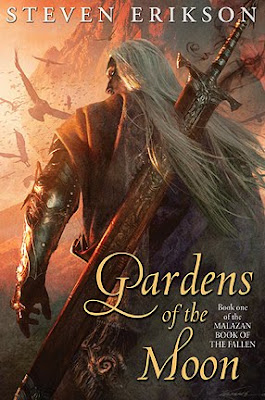
After a while I thought I've started another series of books from the middle or something. A lot of characters, with deep histories, placed in a vast historical context with lots of cool stuff like magic and wars and empires and gods and undead creatures and all that. But no, Gardens of the Moon is actually the first of ten books in the Malazan Book of the Fallen series by Steven Erikson. Wikipedia says: The Malazan world was co-created by Steven Erikson and Ian Cameron Esslemont in the early 1980s as a backdrop to their GURPS roleplaying campaign. In 2005 Esslemont began publishing his own series of five novels set in the same world, beginning with Night of Knives. Although Esslemont's books are published under a different series title - Novels of the Malazan Empire - Esslemont and Erikson collaborated on the storyline for the entire fifteen-book project and Esslemont's novels are considered as canonical and integral to the series as Erikson's own.

The plot is very complex, revolving around the Malazan empire, ruled by empress Laseen, who has just recently staged a coup d'etat and has overthrown and killed the emperor. The empire itself has only one goal, to bring all free cities under its rule, therefore a thick weave of scheming in order to juggle the armies that are partially still loyal to the fallen emperor, the many enemies of the empire, including vary powerful mages and the various high ranking officers who don't see with good eyes what is happening with the empire. And on top of this, Ascendants or Gods are meddling in every important aspect of life. The result is a soup of personal stories, epic battles, shrewd politics and lots of cloak and dagger stuff.

I have to say that I liked the effort a lot, including all the small details that are quite different from books with similar subjects. For example the magic comes from warrens, each a different flavour with influences that diminish and grow like tidal waves and which feed powerful beings whose purposes are never clear or directly expressed. Gods are equally likely to fight amongst themselves, meddle in the human affairs or purely possess some unlucky sod in order to manifest in the real world.

I will now end this entry in order to get the rest of the books in the saga. I highly recommend the book for all fans of fantasy and sci-fi alike.

and has 0 comments
A while ago I was blogging about a Romanian jazzy band called DuteVino. They didn't have an album, just leaked songs over the web, and they sounded rather nice with their female singer having a wide voice range.

After quite a while, they are releasing their first album, "0.1 Prototype", maybe a subtle irony to their lack of activity these past three years, or something to do with all the 2.0s clogging the names of new media. The album itself is formed of their songs so far and, hopefully, it means they plan another soon enough. Nice enough, it is freely downloadable from their site.

The release is due on Friday, December 4th, at 21:30, at Control Club. More information on their official site. If you have difficulties seeing the site, look for a popup poll (which is actually not a popup, but on the edge of the screen) and close it.

and has 0 comments
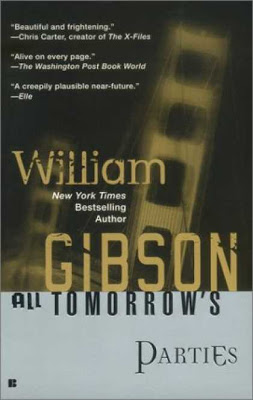
All Tomorrow's Parties is part of the Bridge trilogy, together with Virtual Light and Idoru. Placed in a world that is not too distant from our own, but changed brutally and irreversibly by the advent of new technology, it features some of the same characters as the previous books and tells the story of nodal points, as viewed through the eyes of Laney, the quantitative analyst, and of the people that are inadvertently in the middle of profound change. Laney is a guy that can sense accretions of data intuitively, because he was subjected to trials of some weird drug, and he notices a large nodal point, a place where data points to a change in the way the world works.

I will let you read it and see what this is all going towards. I must say that it felt like an easier book than Idoru, maybe because it has more action sequences and (a bit) less descriptive prose. It is a strange thing to understand the world of Gibson's imagination and feel so strongly about it, yet in the same time see that the world is not really going there. The details that the author infuses in his stories make all of his books seem part of reality and, having finished some story, I feel that the world around me is a bit fake. I believe that is a mark of a great writer.

and has 0 comments
It seems that I started William Gibson's the Bridge trilogy in reverse order. I finished reading All Tomorrow's Parties and, before I could blog it, I started reading Idoru and realized that it was set in the same universe and had some of the same characters. And this only to find out by Wiki'ing that there is a third (and first) book in the series.

Well, I can't possibly hold up until I start and finish that one, and I may even not read it. Not because Gibson is not brilliant, but because the level of attention necessary to enter the atmosphere of his books is not appropriate for my daily subway trips to work. Because of this I recommend reading William Gibson books somewhere alone, in bed, well rested, ready to virtually go somewhere else and abandon reality for a while.

Back to Idoru, a book about a Japanese popular idol (hence the name of the book) who is entirely virtual, a programatic entity made for the sole purpose of entertaining. However, this inadvertently turns into a proper AI, becoming more human as the data from her fans becomes part of her being. Of course, a lot of characters are doing their thing in a typical for Gibson very detailed world that mixes the increasingly neglected realilty with emerging virtual worlds and concepts.

It is a good book, but I recommend you start with Virtual Light, go through Idoru and finish the proper way, by reading All Tomorrow's Parties.

and has 0 comments
After the horrible dissappointment with the third book from the Dexter series by Jeff Lindsay, I even forgot there was a fourth book coming. Thanks to my friend Meaflux, who kindly remembered me to not miss on my education as a serial killer, I found out the fourth book, Dexter by Design, was out and, (thank you, Jeff!), without any of the fantasy monster crap that made Dexter in the Dark so bad.

Dexter by Design was a really nice book. It captured the dark humour only a geeky psychopath would have, caught in a world of emotional people, it added a lot of tension, it went cursively from start to end. The only problem I could possibly have with it is that it made Dexter look bad, easily surclasses by not one but three people on three separate ocasions.

The conclusion is that it was one of the best, if not THE best in the series. Not a lot of killing is done, though, not by Dexter in any case. And if you are wondering, it has no connection with the third season of the Dexter TV series, except for the ending :).

and has 0 comments
The last book (in story time) in the Deepgate Codex series, God of Clocks was a huge disappointment. It started nicely enough, preparing us for epic battles of wit and weirdness. Reading it, I was about to forget all about the slight drop in quality in the second book, Iron Angel, and was preparing for something grand. Then Mr. Campbell did what he never should have done: he altered the time space continuum. Before I knew it I was thinking at that old sci-fi movie where a ship boards another ship while in hyperspace and because of chaotical relativistic effects they all end up getting old, then young, then meeting themselves, fighting along their older grandsons, fighting the enemy with sticks and so on. For the love of God, I don't remember the name and I did Google it, but got only crap pages.

Anyway, Mr. Campbell, haven't you watched sci fi movies until now? Haven't you read a lot of SF books that make the same mistake, drowning in their own pool of possibilities. Time travel, unless it is the main subject, always messes up a story. And I was already confused with all the gods that were nothing more than angels with over inflated egos that anyone could capture and kill, the assassin that turned into mother-do-good, the boy demon who thought John Anchor was his father and that little child that is older and more powerful than him... so all this became very jumbled. No wonder a lot of the threads just remained hanging. What happened to Devon? Who the hell was the little girl? What did Carnival do? Everything just got negated by a race towards the beginning of time, when Ayen blocked the gates of Heaven. And then poof! A lot of fast scan scenes and the book ended. The fight never took place, or if it did, it was never described. And don't worry, if you preferred any other ending, there must be a broken timeline floating like a disolving icecube in a water glass that you can climb on and enjoy whatever reality you desire.

This book must be one of the most (if not THE most) WTF book I have ever read. In the end I was pacing, swearing and regretting my lost time. If the Deepgate Codex series would have been a video game, it would have never been released, with all the lack of documentation and obvious bugs.

My conclusion: what a nice beginning with Scar Night, but what a faltering fiasco up to and through God of Clocks. It did manage to make me think of a book where the main character would be Carnival, and all the rest would be just detail. I just loved her character and I feel so unfulfilled because it was never properly developed.

and has 0 comments
If you watched one of the episodes of Rescue Me you possibly have noticed that there is a cool song in the opening. It is Com'on Com'on by Von Bondies. Here is a live performance for Letterman's Show:

and has 0 comments
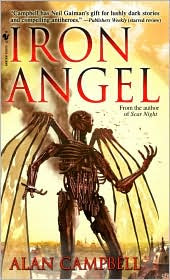
Iron Angel starts where Scar Night left us. Even if the scope of the story now expands tremendously, doing credit to the author's imagination, I didn't feel so good reading it as I did Scar Night. Frankly, I don't know exactly why. It may have to do with the several character groups in the plot, which we follow separately for quite some time and that I know are bound to encounter each other or influence each others destinies. When that fails to happen for a long time, I get nervous. Also, while the description of hell was very nice, I found it difficult to swallow.

That doesn't mean it is not still a brilliant story, just that it seemed to falter a little in the middle. Now, almost close to the end of God of Clocks, I can say that the quality will improve, at least as measured from my own level of pleasure, although it doesn't get close to Scar Night yet.

I love that Alan Campbell really worked on his characters, making them very different to the formulas we are used to see in the field. Heroes are cowardly and impotent, women are strong, gods are flawed and some characters are simply likeable even if they don't see reason and exist for the sole purpose of physical revenge.

I can say that God of Clocks is at least intriguing, although I have to ask myself if the author didn't bite more than he can chew with the new concepts involved. Anyway, that is another post, coming soon on a blog near you.

and has 0 comments
I was reading this interview of the guy from The Wertzone blog, a Sci-fi and fantasy blog that I enjoy reading, and he recommended some movies and some games and some books. So, on his recommendation, I started reading Scar Night, by Alan Campbell, and I have no reason to regret my decision (other than the one I will not be able to read another technical book until I finish the saga).

The writing style is nice, although I wouldn't say it rocked my world, however the world the author has envisioned is really great. Imagine a large city built upon great chains of alien metal, suspended over hell itself, inhabited by people worshiping a version of the devil, their church defended by angels called archons and armies of assassins. There is more, but you just have to read the book. What I also enjoyed tremendously is that the characters are very different from one another, ranging from mad scientists to priests corrupted by their desire for the greater good, from good hearted assassins to undead gods and inept cowardly angels.

I can only recommend you read this book, the first from the Deepgate Codex trilogy. Funny enough, the writer, Alan Campbell, was one of the authors of the Grand Theft Auto game, so he is also a software developer. I am hooked.

Did I mention I love how this guy writes?


and has 0 comments
Ugh! The fifth book of the Revelation Space series , The Prefect, is the worst so far. Not only is it standalone, but it is also a prequel, something that happends pre-plague. All the characters seem to have been lobotomized some time in the past (possibly in an operation that also mixed their brains around so that they all sound and act the same), including the bad guys, and the story is completely boring. Nothing in this novel makes any sense, nor does it make you feel anything special, quite the contrary, the scenes that were supposed to bring out feelings for the reader felt really forced and had the opposite effect.

The only good thing in the book was the ClockMaker, all 10 pages of it or whatever. Couldn't you start with the ClockMaker, continue with the ClockMaker and end with the ClockMaker and forget all about the stupid and randomly emotional people, mr Reynolds?

First time I've ever heard of cymatics and I am intrigued. basically you use some (physical) devices to visualize soundwaves. Here is a small TED presentation about it:


My question is simple: can this be used to "understand" sounds for deaf people or are the pattern transitions too complex? googling for cymatics I've found a lot of videos about water and cornstarch moved by sound and links to "sound healing" and even some technical papers that never seem to have left academia. I think this could be interesting enough to emulate on a computer, yet I have not found code for it yet.

and has 0 comments

The fourth book by Alastair Reynolds that I've read recently, also set in the Revelation Space world, Absolution Gap follows the adventures of the ship Nostalgia for Infinity as it flees the "culling" of the Delta Pavonis star system by the swarm like machines called the Inhibitors. There is no purpose in reading the book without the others, as the story starts where it had left and continues to a more or less open ending.

This felt like the best book so far, however the enjoyment that I got from it had its very brutal ups and downs. While the beginning starts with full force and made me want to not let go of the book until I finish it, there was a side story that seemed not to have any connection with the main arc. When they finally met, they left me with that "What the fuck?" feeling. The ending was a jiggly up and down ranging from very cool and completely dumb. Not that the writing style faltered, but the behaviour of some of the characters really annoyed the crap out of me.

I would have to say that the ending was the most anticlimactic of all the books in the series, but the book is definitely the best yet.

and has 0 comments
Count Zero is the middle volume of the Sprawl trilogy written by William Gibson, which includes Neuromancer, Count Zero, and Mona Lisa Overdrive, all of them very good books and set in the same universe as the short stories Johnny Mnemonic, New Rose Hotel and Burning Chrome.

I had read this book when I was a child and I loved it a lot. Circumstances moved me towards reading it again and I am glad they did. In my youth I had barely understood it and I can't say I did a lot better now either; that's because Gibson is one of the mature writers, writing for the mind and heart of adults.

Count Zero in particular, it felt like something one must feel through bones, must sip the content like a good coffee and digest the content with one's soul. Alas, I am not that kind of a guy, so I read it fast in the subway while going to work, in big gulps, like the glutton I am. I highly recommend the former approach ;)

The plot itself is like a high tech detective story, but it is almost irrelevant. Gibson has such a clear and powerful vision of the future, that it subjugates all of its characters to it and makes it, the future, the main character. Many things are not said, but left to be understood, like the reasons while the world is the way it is and why people act the way they do. Read Count Zero, even if you are not a sci-fi reader, because beyond the storyline there are layers upon layers of worldliness and it is a great book.

and has 0 comments

It wasn't a very memorable trip, but I had to write this because of the Bohemi hotel in Arbanasi, which must most certainly be avoided. And it was, overall, a nice holiday. But let me take it from the beginning.

We took the car starting up from Bucharest and went towards Veliko Tarnovo. We passed through Basarbovo, to visit the rock monastery there. Very nice place, if you like churches. They have these small rock dug rooms where priests used to live and pray and then the monastery which was in renovation when we came there, but had a very lovely garden.

We then moved towards Cherven, where we visited the castle dig which is archaeologically active. It is a large XIV century Christian fortress, where one can see how people lived in the day: small one room living quarters and then a gazillion churches, large and small, then some administrative buildings and some defence walls and watch towers. There are about 200 stair steps to reach the castle from where the car road ends.

Next was Ivanovo. Some other rock monasteries, but everything set inside a natural reserve, a very beautiful place.

Then we went towards Arbanasi, a touristic area where there are a lot of hotels and where we arranged for accomodations. The hotel we chose was a three star hotel called Bohemi, boasting internet, minibars, outdoor oven, breakfast, etc, depending on the tourist site you search for it. Let me tell you how it really is: it's a two star hotel with smelly rooms, no parking, invaded by insects and spiders (and a scorpion which scared the craop out of my wife), no internet, no minibars, with a breakfast as the ones from the communist era: some bread and butter and jam and some salami/cheese slices. The hotel itself is one of many owned by the same people, so the person serving there is only an employee, put there to mind the place. In the room, after we got used with the stale odor of moist walls, we noticed that we has not enough sheets and two out of four light bulbs were not functioning. Really, I can't stress enough: 35 euros per night?! In times of economic crisis and with this kind of service? Avoid!

Arbanasi itself is not a bad place to stay, eat, sleep, and then back again. It would have killed me with boredom if I didn't have a car. They have a monastery there, but by then I got tired of any type of religious building. The restaurants where very nice, but service was consistently bad. I haven't seen dumber waiters in quite a while.

Veliko Tarnovo is a large city, once the capital of the second Bulgarian empire.

The stronghold there is a very nice place, where they don't allow sale people and where people can see theater and sound/light shows in the evening. Very large, beautiful and accomodating. Then there are some monuments and some nice streets.
The city itself is pretty cool. Lots of churches, of course :) I am sure that, being with my parents, I missed a lot of the hidden beauty of the town, but it was nice nonetheless.


That was about it. Take the links to get more information. My general opinion of Bulgaria is that it is a nice country, beatiful and wild, but rather poor. All the small towns and villages we passed through looked half abandoned, with many disaffected buildings and very few people. The economic crisis must have hit them pretty hard, too.